Schopenhauer war ein Pessimist und Atheist, tief vom Hinduismus und Buddhismus beeinflusst; seine Moralphilosophie basiert auf dem Mitleid mit Mensch und Tier. (Schopenhauer was a pessimist and atheist, deeply influenced by Hinduism and Buddhism; his moral philosophy is based on compassion with man and animal.)
Im folgenden einige Zitate, die meisten aus dieser Auslese seiner Zitate (in the following some quotes, most from a collection of his quotes, English translations by me):
GLAUBEN UND WISSEN (FAITH AND KNOWLEDGE)
Glauben und Wissen verhalten sich wie die zwei Schalen einer Waage: in dem Maße, als die eine steigt, sinkt die andere.
Faith and knowledge act like the two pans of a balance: one pans sinks as much as the other rises.
EWIGES LEBEN (ETERNAL LIFE)
Das Leben kann als ein Traum angesehen werden und der Tod als Erwachen.
Life can be viewed as a dream, and death as an awakening.
Hierzu: Thomas Mann, in enger Anlehnung an Schopenhauers Worte, interpretiert das so: “Der Tod ist nichts als die Aufhebung eines Irrtums…….Er ist nichts als das Verschwinden einer illusionären Scheidewand, die das Ich, in das du dich eingeschlossen findest, von der übrigen Welt trennt……….diese Welt, die deine Vorstellung ist, wird nicht mehr sein, du aber, nämlich gerade das in dir, was den Tod scheut, was ihn nicht will, weil es der Wille zum Leben ist, – du wirst bleiben, wirst leben, denn der Wille, aus dem du bist, wird das Tor zum Leben immer zu finden wissen. Ihm gehört ja die ganze Ewigkeit…..” (On this point: Thomas Mann, closely following Schopenhauers words, interprets this as follows: “death is nothing but the removal of an illusionary wall that separates the “I” in which you are enclosed, from the rest of the world…….this world, which is your “Vorstellung” (imagination) will not exist anymore, however you, i.e. just that part of you which is afraid of death and does not want death, because it is the will to live – you will remain, will live, because the will, of which you exist, will always find the gate to life. Because all of eternity belongs to it…….”)
ÜBER DEN CHARAKTER DES MENSCHEN (ABOUT THE CHARACTER OF MAN)
Die Geschichte ist eine Fortsetzung der Zoologie.
History is a continuation of zoology.
Die Perfektion der Mittel und die Verwirrung der Ziele – das scheint unsere Zeit zu charakterisieren.
The perfection of the means and the blurring of goals seem to characterize our time.
Die Wilden fressen einander – die Zahmen betrügen einander.
Savages devour each other – civilized people betray each other.
Mein unerschütterliche Glaube an die Dummheit des Tieres Mensch hat mich nie enttäuscht und ist mir im Lauf des Lebens oft zustatten gekommen.
My unshakeable belief in the stupidity of the animal man has never disappointed me and has often helped me throughout my life.
Viele verlieren den Verstand deshalb nicht, weil sie keinen haben.
Many do not lose their mind because they do not have one.
Der Rang….ist…..eine Komödie für den großen Haufen.
One’s status (rank)….is……. a comedy for the masses.
(Schopenhauer, Aphorismen)
ÖKONOMIE (ECONOMICS)
Sokrates sagte beim Anblick zum Verkauf ausgelegter Luxusartikel: Wie vieles gibt es doch, was ich nicht nötig habe.
Sokrates in front of articles of luxury spread out for sale: How many things there are which I don’t need.
(Schopenhauer, Aphorismen)
PATRIOTISMUS (PATRIOTISM)
Jede Nation spottet über die andere, und alle haben recht.
Each nation ridicules the other, and all are right.
(Schopenhauer, Aphorismen)
ÜBER DIE FRAUEN (ABOUT WOMEN)
Der einzige Mann, der wirklich nicht ohne Frauen leben kann, ist der Frauenarzt.
The only man who really cannot live without women is the gynecologist.
Hierzu: Schopenhauer hatte eine Reihe von Affairen und hinterliess einen Teil seines Geldes einer früheren Geliebten, einer Berliner Schauspielerin (On this point: Schopenhauer had a number of love affairs and left some of his money to a former lover, a Berlin actress.)
MITLEID ALS DIE BASIS DER MORALITÄT (COMPASSION AS THE BASIS OF MORALITY)
Die vermeintliche Rechtlosigkeit der Tiere, der Wahn, dass unser Handeln gegen sie ohne moralische Bedenken sei, ist eine geradezu empörende Barbarei des Abendlandes. Die Tiere sind kein Fabrikat zu unserem Gebrauch. Nicht Erbarmen, sondern Gerechtigkeit ist man den Tieren schuldig.
The supposed rightlessness of animals, the delusion that we can act towards them without moral scruples, is a really disgusting barbarity of the Western world. Animals are not constructs for our use. We owe them justness and not mercy.
Mitleid mit Tieren hängt mit der Güte des Charakters so genau zusammen, dass man zuversichtlich behaupten darf: wer gegen Tiere grausam ist, kann kein guter Mensch sein.
Compassion with animals is connected with the goodness of character to such a degree that one can maintain with confidence: he who is cruel to animals, cannot be a good person.
Ethik kann so wenig zur Tugend verhelfen, als eine vollständige Ästhetik lehren kann, Kunstwerke hervorzubringen.
Ethics can help us to behave morally as little, as aesthetics can teach us how to produce works of art.
Hierzu: Schopenhauer hinterliess Geld, das für die Sorge um seinen Pudel “Atma” (Weltseele) bestimmt war. Er war ein strikter Gegner jeglicher Vivisektion an Tieren (On this point: In his will, Schopenhauer left some money to be used for the care of his poodle “Athma” (world soul). He was strictly opposed to any vivisection on animals.)
FREIHEIT DES WILLENS UND TOLERANZ (FREEDOM OF WILL AND TOLERANCE)
Siehe hierzu den Abschnitt “Der Einfluss Schopenhauers” (On this point see the section “The Influence of Schopenhauer”)
KUNST (ART)
Ein grosser Teil von Schopenhauers Philosophie beschäftigt sich mit Kunst, insbesondere Musik; Schopenhauer wird oft als der Philosoph der Kunst bezeichnet. (A large part of Schopenhauer’s philosophy deals with art and particularly music, Schopenhauer, indeed, has been called the philosopher of art.)
DER EINFLUSS SCHOPENHAUERS (THE INFLUENCE OF SCHOPENHAUER)
Der Einfluss Schopenhauers war und ist sehr gross, vor allem auf Künstler einschliesslich und insbesondere Musiker. Richard Wagner, zum Beispiel, widmete seine Oper Tristan und Isolde dem Philosophen (Schopenhauer war jedoch nicht beeindruckt und zog Rossini vor). Nietzsche, Freud, Wittgenstein, um nur einige von vielen zu nennen, waren von ihm beeinflusst. (Schopenhauers influence was and is great, particularly on artists including and especially musicians. Richard Wagner, for example, dedicated his opera Tristan and Isolde to the philosopher (Schopenhauer, however, was not impressed and preferred Rossini). Nietzsche, Freud, Wittgenstein, among many others, were influenced by him).
Hier ein kurzer Auszug aus Albert Einstein: I Believe (1940) (Here a brief excerpt from “Albert Einstein: I Believe” 1940):
“I do not believe we can have any freedom at all in the philosophical sense, for we act not only under external compulsion but also by inner necessity. Schopenhauer’s saying – “A man can surely do what he wills to do, but he cannot determine what he wills” – impressed itself upon me in youth and has always consoled me when I have witnessed or suffered life’s hardships. This conviction is a perpetual breeder of tolerance, for it does not allow us to take ourselves or others too seriously; it makes rather for a sense of humour.” (I glaube nicht, dass wir Freiheit im philosophischen Sinne besitzen können, da wir nicht nur durch äusseren Druck sondern auch durch innere Notwendigkeit handeln. Schopenhauers Aussage – ein Mensch tut sicherlich was er will, doch kann nicht bestimmen was er will – hat sich mir in meiner Jugend eingeprägt und hat mich immer getröstet, wenn ich an des Lebens Härte litt. Diese Überzeugung ist eine andauernde Quelle der Toleranz, da sie uns nicht erlaubt, uns zu ernst zu nehmen; im Gegenteil – sie ist eine Quelle des Humors.
ÜBER SCHOPENHAUER (ABOUT SCHOPENHAUER)
Fast jede zusammenfassende Darstellung grosser Philosophen hat einen Abschnitt über Schopenhauer (z.B. Russell 1946, sehr kurz und praktisch nichts über seine Philosophie der Kunst), und einige ausgezeichnete Essays sind ihm gewidmet. Thomas Mann 1938, zum Beispiel, hat einen sehr einfühlenden Aufsatz über ihn und seinen Einfluss geschrieben. (Almost each comprehensive discussion of great philosophers contains a section on Schopenhauer (for example Russell 1946: very brief and practically nothing on his philosophy of art), and some outstanding essays are devoted to his philosophy. Thomas Mann 1938 has written a very emphatic essay about him and his influence). A good essay on Schopenhauer’s philosophy was published in the online Stanford Encyclopedia of philosophy:
http://plato.stanford.edu/entries/schopenhauer/
Die Zitate wurden ursprünglich in meinem blog veröffentlicht (quotes originally published in my blog): http://blog.une.edu.au/klausrohde/2008/03/08/a-crash-course-on-schopenhauer%E2%80%99s-philosophy-ein-schnellkurs-uber-schopenhauers-philosophie/
und (and) hier.
QUELLEN (SOURCES)
- Schopenhauer’s Sämmtliche Werke in Fünf Bänden. IV. Band. Aphorismen zur Lebensweisheit. Grossherzog Wilhelm Ernst Ausgabe, Insel Verlag Leipzig.
- I Believe. Nineteen Personal Philosophies, Unwin Press, London 1940.
- Thomas Mann: Schopenhauer (1938). In : Leiden und Grösse der Meister. Fischer, Frankfurt am Main und Hamburg 1957.
- Bertrand Russell: History of Western Philosophy. George Allen & Unwin, London 1946. (Geschichte der Abendländischen Philosophie).
Arthur Schopenhauer: Ethics and Theory of Justice
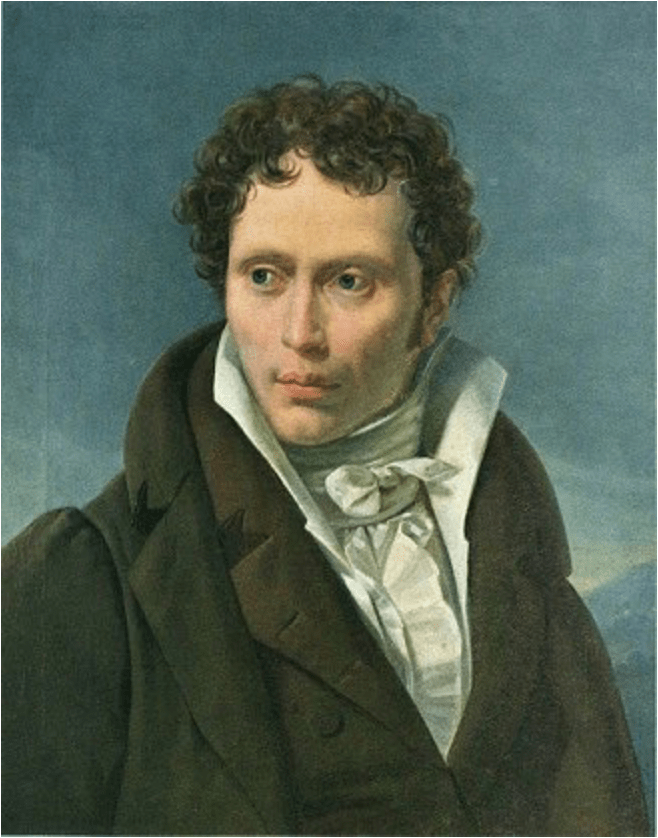
Schopenhauer’s philosophy and influence
Schopenhauer’s ethics and theory of justice follow from his epistemology, according to which the world as it appears to us, as we perceive it, is to a large degree shaped by our mental apparatus. Following Immanuel Kant, he assumes that time, space and causality are not characteristics of the thing-in-itself (“Ding an sich”) but categories of our mind. All distinctions between individuals disappear once these categories are taken away. In other words, all beings are in essence One. Schopenhauer differs from Kant in concluding that we can indeed make some statement about the characteristics of the thing-in-itself. This is possible because we are not only individuals who perceive the external world, but also the subjects of perception. These subjects are essentially Will.
Schopenhauer’s ethics has had a deep influence on many philosophers and writers after him. Albert Einstein, for example, mentions Schopenhauer as an important influence on his views. Schopenhauer was the first who arrived at conclusions similar to those in Eastern philosophy, in particular Hinduism and Buddhism. And he was the first in Western philosophy who based ethics on compassion with man and animals. Friedrich Nietzsche began as a follower of Schopenhauer but soon developed radically different views.
All citations (in parantheses) are my translations based on Schopenhauer’s collected works [1]. In important cases, exact equivalents of German and English terms do not exist. Even “Vorstellung” in the title of his main work cannot be unambiguously translated into English; it has been translated as idea, imagination, representation, perception, none of them entirely satisfactory. Indeed, Schopenhauer himself has published a theory of language in which this problem is addressed. This theory has for example influenced the important linguistic philosopher Ludwig Wittgenstein. – In doubtful cases, I give my English translation and the German original.
Schopenhauer Ethics: affirmation and negation of the Will, tat twam asi
The fourth book of Schopenhauer’s main work, The World as Will and Perception (Welt als Wille und Vorstellung) deals with Schopenhauer’s ethics. He considers this book as the “most serious” one, because it discusses the actions of man and is therefore of concern to everybody. He emphasizes that ethics cannot teach morality, as little as aesthetics can teach us how to become a genius.
As pointed out in earlier sections of the World as Will and Perception, individuality is a feature of the perceived world, but not of the thing-in-itself. Therefore: “Death is a sleep in which individuality is forgotten: everything else awakens, or rather has stayed alive”. Deep sleep, while it lasts, differs from death only with respect to the awakening. The will, the thing-in-itself, is One (i.e., all individuals will join it after their death), and it (its intelligible character) is free, since it is not subject to the categories of causality, time and space. The empirical character however, as perceived by us, is strictly, in all details, determined. Everybody considers himself a priori free in the sense that he is able to perform any action, and he learns to know his own character only a posteriori, by experience. That is, “the intellect experiences the decisions of his will only a posteriori and empirically. He has, before a decision, no information (“datum”) about what decision the Will will make.” “The claim of an empirical freedom of Will ….. is a consequence of the misguided attempt to place the essence of man into a soul…” In this context Schopenhauer’s introduction of the term acquired character(in addition to the intelligible and empirical character) is interesting: it is a human’s character (whether our own or that of others) with all its strengths and weaknesses revealed by long experience.
The world, as an everlasting struggle of all against all, is even in principle a place of suffering. “ The basis of all willing is indigence, scarceness, therefore pain to which a human is exposed primordially and by its essence. When objects of his desire are missing because fulfillment of the desire has been too easily granted, he is overcome by a terrible emptiness and boredom: i.e., his being and existence become an unbearable burden”. “This is strangely also expressed by the fact that – after man has put all suffering and agony into Hell, nothing but boredom is left for Heaven.” “Life of most is an everlasting struggle for existence itself, in the certainty that it will finally be lost. The reason why one persists in the arduous struggle is not love for life, but fear of death”. – Satisfaction, happiness is always only negative, since every desire, i.e. scarceness, is the preceding condition of the desire. Altogether, permanent satisfaction cannot be attained.”
Schopenhauer mentions examples from history and hospitals, among others, in support of his thesis.
How can we escape from this hell? By renunciation, negation of the Will. Thus, the voluntary negation of the satisfaction of the sexual urge, not based on a motive, is a negation of the Will to life. However, it is unjust to negate the Will in another body, i.e., in order to harm or destroy it, either by deceit, lie or force. Proceeding from this, Schopenhauer develops a theory of ownership, of natural justice and law in general. Injustice is the original and positive, justice the derived and negative concept. “The only purpose of law is determent from encroaching on others’ rights”. Schopenhauer considers Kant’s thesis that humans should always be considered to be the end (“Zweck”) and never as means, as vague and problematic, because “a murderer sentenced to death must with full justification be used as means”, as a determent and for the re-establishment of public security. However, this applies only to justice in time (“zeitliche Gerechtigkeit”), eternal justice which applies to the entire world (that is, lies in its essence) and does not depend on human constructions (“Einrichtungen”), cannot be retaliatory, because it lies not in time unlike justice in time which is based on retaliation. “Punishment must here (in eternal justice) be connected with the crime in such a way that both are one.” If one wants to know what humans as a whole and in general are worth from a moral perspective, one only has to look at their fate as a whole and in general. This is indigence (“Mangel”), misery, agony and death. Eternal justice at work…..”. However, the “crude individual” has a different view, since he knows only the temporally and spatially separate appearances: he sees tormentors and murderers on the one side and sufferers and victims on the other, who are really only One. Nevertheless, in the depth of his consciousness he sometimes has the “somewhat dark hunch” that “all this is not entirely foreign to him”. Horror (“Grausen”) is founded on this sometimes appearing hunch. All evil in the world derives from the Will which is the real essence of each single person. Hence (Schopenhauer quotes Calderon’s “Life as Dream”, in which the Christian dogma of original sin is expressed: “Since the greatest guilt of man is that he was born”). – Esoterically depicted in the Vedas and especially in the Upanishads, the myth of transmigration expresses the cognition of eternal justice in an easily understandable form for the people. You must not kill an animal, because at a time in eternity you will be born as such an animal and suffer the same death”. This is the meaning of “tat twam asi” (This is you), which is the foundation of Hindu teaching. – In the same sense Christian ethics forbids retaliation of evil with evil and submits to eternal justice (“Revenge is mine, I shall retaliate, says the Lord”).
Our discussion to this point permits a description of the ethical significance of action. According to Schopenhauer, genuine virtue can come only from the insight which recognizes in a foreign being the same being as one’s own. “In principle (“an sich”) all deeds…. are just empty images, and only the attitude (ethos, “Gesinnung”) that leads to them, lends them moral significance.” The principle of justice (based on the negation of evil) commands that one must not hurt others.” Genuine goodness goes much further and leads to love of mankind (“Menschenliebe”): one distinguishes much less than usually between oneself and others, one sacrifices one’s property and even oneself to one’s neighbour (“Nächster”) and one does not torture an animal. Love is based on the recognition of foreign suffering and pure love is therefore by its nature compassion. All this is in direct contradiction to Kant’s view that any truly good and virtuous deed is based on abstract reflection, on the concept of duty and the categorical imperative. – Cryingis compassion with oneself. – When a human does no longer distinguish between himself and another human, and when he participates as much in the distress of others as in his own, and when he sees all the suffering in the world, he arrives at resignation, the condition of voluntary renunciation (“Entsagung”). The Will turns away from life. “Essentially nothing but appearance of Will, it ceases to will anything…. “Chasteness is the first step in asceticism or the negation of the Will to live”. – With the total abolition of perception the rest of the world would disappear into Nothing….” This idea was also expressed by Christian mystics, for example Angelus Silesius and Meister Eckhard, and in Buddhism (entrance into the nirwana).- Asceticism is also shown by voluntary indigence, such as the one practiced by Franciscus of Assisi.
In this sense Schopenhauer’s pessimism must be understood, and he shares it with original Christianity (e.g., Augustinus) resurrected by Luther, the Christian mystics, Hinduism and Buddhism, but not with the old testament and the non-Lutheran Protestantism, whom he accuses of hollow optimism.
Suicide is not a way to escape from the misery of this world. “Far removed to be a negation of the Will, it is indeed a phenomenon of affirmation of the Will. For negation consists in its essence not in loathing the sufferings but the pleasures of life. A suicide wants life but is unhappy with its conditions, under which he has to suffer. Therefore he does not renounce the Will to life, but only life by destroying his appearance in life.” For similar reasons Schopenhauer opposes contraception, abortion and the “promotion (“Beförderung”) of killing newborns”. The Will to life can only be abolished by perception, that is, the Will must appear unobstructed in order to perceive its own essence.
But can the negation of the Will to life in the sense just discussed (as “renunciation without a motive”) be reconciled with the ascertainment that “all causes are only opportunity causes (“Gelegenheitsursachen”) which show themselves with the necessity of a natural law? Schopenhauer says “In truth real freedom can be attributed only to the Will as thing-in-itself but not its appearance…”
Schopenhauer’s views on some specific problems in justice
From volumes I and II, Die Welt als Wille und Vorstellung, quotes in parentheses.
Property (I, pages 442ff): Injustice (“Unrecht’) is the incursion into the affirmation of life (“Lebensbejahung”) of another person. Hence, property which cannot be taken from another without injustice is exclusively that which the other has worked on (“bearbeitet hat”). A simple declaration to exclude others from the use of a thing does not establish a right. There can be no seizure (acquisition of possession) in law without previous application of one’s own labour (work, “Kräfte”). Enjoyment of a thing, without any work or without securing it against destruction, does not give a right of possession. Hence, even if a family has hunted exclusively in a region for a century, without having contributed anything to its improvement, it cannot prevent somebody else from hunting there without committing moral injustice.
Defence (I, pp.448ff): I have the right to negate any foreign negation with the force necessary to overcome it, even if it implies killing the foreign individual, because negation of negation is affirmation within my personal sphere of affirmation of life, and not negation of the foreigner.
Role of the state (I, pp.459ff.): A state’s function is protection of everybody against suffering injustice. People renounce committing injustices and, in turn, agree to carry the burden of maintaining the state. Laws and punishment enforcing them are directed towards the future, not the past. This distinguishes punishment from revenge, the latter concerned with the past. Retaliation for an injustice by administering pain, without use for the future, is revenge, and can have only one purpose: to console somebody for his suffering by looking at foreign suffering that one has caused. This is malice and cruelty and cannot be justified ethically. Injustice committed by somebody does not entitle me to do injustice. It is therefore senseless to accept the jus talionis as an autonomous final principle of criminal law. “The only purpose of law is determent from encroaching on others’ rights”. Kant’s theory of criminal law based on retaliation for retaliation’s sake is utterly without basis and wrong. Schopenhauer emphasizes that his views on the theory of punishment are not new but go back to Plato, Hobbes, Feuerbach, and Puffendorf.
(II, pp.1400): “those who with Spinoza deny that there is Right outside a state, confuse the means to enforce justice with justice itself…..it exists independent of the state.”
REFERENCES
- Schopenhauer’s Sämmtliche Werke in Fünf Bänden. Grossherzog Wilhelm Ernst Ausgabe, Insel Verlag Leipzig. I. Die Welt als Wille und Vorstellung Teil I. II. Die Welt als Wille und Vorstellung Teil II. III. Kleinere Schriften. IV. Parerga und Paralipomena. I. Teil. V. Parerga und Paralipomena. II. Teil.
Space, time and causality in Kant’s and Schopenhauer’s philosophy, and in physics. The role of our consciousness.
ABSTRACT
Are Kant and Schopenhauer right after all? Are the evolutionary philosophers wrong who claim that our mind accurately reflects the objective world? It seems that our mind has evolved in adaptation to the objective world, but only as far as is necessary to survive in the immediate environment. In other words, our mind is faulty; space, time and causality may be ‘working tools’ to find our way in daily life, but our mind cannot accurately perceive the real essence of the objective world, which may not lie in space and time and not be causal. All our ideas about this ‘spooky’ world are indirect, derived by means of complicated mathematics from experiments that explore only the objective world but say nothing about the subjective (conscious) side of it.
Since the first beginnings of Western science in ancient Greece, philosophers speculated about the outside world. Democritus assumed that the world was not really what it appears to be, but that there was reality only in atoms and the void. Galileo Galilei, Descartes and Newton did not believe that the world is what it appears to be. According to John Locke (1689), all knowledge is acquired by experience through sensory perceptions. He distinguished primary and secondary qualities: the former are properties which are independent of the observer and include solidity, extension, motion, and numbers. The latter are properties which are produced by sensations in the observer, such as colour, smell and sound, and do not provide objective facts about nature. Or: primary qualities can be measured, secondary ones are purely subjective. He did not accept that there are innate ideas. David Hume (1739) believed that we can only know objects of experience and relations of ideas. Our belief in causality results from habit, the experience of ‘constant conjunction’. We have no conception of the self, we are only bundles of sensations. Berkeley and Leibniz among others doubted that primary qualities are really properties of the world, and Immanuel Kant (1781) claimed that space and time, as well as causality, are categories of our mind, i.e., features which are necessary to form experience. The thing in itself (the noumena), which is the ground for the phenomena experienced by us, cannot be perceived by us. Schopenhauer (1818), in his ‘Welt als Wille und Vorstellung’ agreed with Kant concerning the categories of our mind, but goes further in saying that the experienced phenomena and the thing in itself are different sides of the same ‘coin’, and that we do indeed have access to the thing in itself, because we are not only objects of perception, but also subjects who do the perceiving. He identified the thing in itself as essentially Will. I refer to it as consciousness (See also Remarks below).
Some later philosophers (e.g., Bernhard Rensch), under the impression of the theory of evolution, suggested that our mind has evolved in adaptation to the external world, the environment, and that the categories of our mind, space, time and causality, therefore reflect real characteristics of the objective world.
Here I suggest that the latter proposition, that our mind has evolved in adaptation to the objective world and thereforereflects it, may be faulty. Particle physics has taught us that energy/matter is quite different from the solidity of matter earlier claimed to exist and experienced by us (how many neutrinos pass through our body every second without being noticed, for example ?). The phenomena of quantum superposition and entanglement may perhaps suggest that space and time are not real characteristics of the world. When two particles, located far apart even in different galaxies, are entangled, a measurement of one of them will immediately, without any time delay, give us information about the other. Or: when we measure the state of a particle, we collapse its superposition, determining its state and thereby the state of the other, with which it is entangled. This is seemingly in contradiction to the Theory of Relativity. (Einstein did not accept this postulate of quantum physics and referred to is as the ‘spooky action at a distance’). However, the phenomenon has now repeatedly been shown experimentally to exist (although not yet at galactic dimensions!). If particles are entangled, information about them is not separated in time or space, although there is no causal action at a distance. Murray Gell-Mann illustrates this with Bertlmann’s socks. The mathematician Bertlmann always wore one pink and one green sock, so seeing let’s say a green sock on him we know immediately that the other one must be pink. Likewise, measuring (determining) a certain type of polarization of one photon, we know immediately (determine) what the polarization of the other, entangled photon must be, even if both are separated in space. (The sock illustration, however, is not entirely correct. It ignores that in the quantum world two states of entangled particles do not exist before they are measured, whereas the socks are really red and green, whether we look at them or not).
Is this evidence that Kant and Schopenhauer were right after all? Are the evolutionary philosophers wrong who claim that our mind accurately reflects the objective world? It seems that our mind has evolved in adaptation to the objective world, but only as far as is necessary to survive in the immediate environment. In other words, our mind is faulty; space, time and causality are ‘working tools’ to find our way in daily life, but our mind cannot accurately perceive the real essence of the objective world, which may not lie in space and time and may not be causal. All our ideas about this ‘spooky’ world are indirect, derived by means of complicated mathematics from experiments that explore only the objective world but say nothing about the subjective (conscious) side of it.
I put this up for discussion.
REFERENCES
- John Locke (1689). Essay concerning human understanding.
- David Hume (1739). A treatise on human nature.
- Immanuel Kant (1781). Kritik der reinen Vernunft (Engl.transl. Critique of pure reason).
- [Also: Prolegomena zu einer jeden künftigen Metaphysik die als Wissenschaft wird auftreten können (1783) (Engl.transl. Prolegomena to any future metaphysics that will be able to present itself as science.]
- Arthur Schopenhauer (1818). Die Welt als Wille und Vorstellung (Engl. transl. The world as will and representation).
- Bernhard Rensch (1968). Biophilosophie (Engl. transl. Biophilosophy 1971).
- Murray Gell-Mann (1995). The Quark and the Jaguar. Adventures in the Simple and the Complex. Abacus.
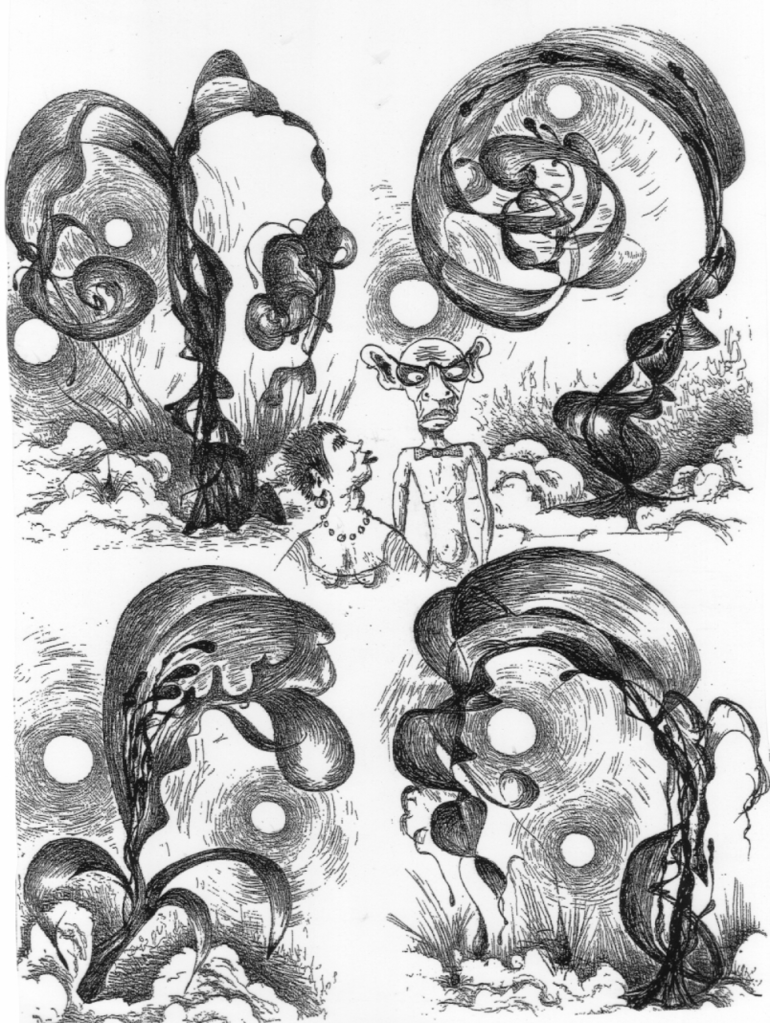
Remarks: “Die einzig mögliche Interpretation ist, dass das Bewusstsein die sozusagen ‘andere, subjektive Seite’ bestimmter (wenn nicht aller) Nervenprozesse ist: ein Physiologe misst was sich im Nervensystem abspielt, und das Individuum erlebt, was er misst. Oder: Bewusstsein kann nur subjektiv empfunden werden, und nur Analogieschlüsse erlauben mir, auch bei anderen Menschen und Tieren ein Bewusstsein anzunehmen. – Dies hat enorme Konsequenzen für unser Weltbild. Es existiert eine Welt der physikalisch/chemikalischen Prozesse, die wir beobachten und messen können, und daneben eine Welt des Bewusstseins, die man nur empfinden kann. In der körperlichen Welt herrschen strenge (vielleicht kausale) Gesetzmässigkeiten, in der subjektiven Welt fühlen wir uns frei, meinen wir könnten machen was wir wollen. Da die physikalisch/chemische Welt ‘unsterblich’ ist (???? zumindest vom big bang bis zum vielleicht nächsten) ist auch das Bewusstsein unsterblich, da es ja mit der körperlichen Welt verbunden ist.” Zitat aus:
Stephen Wolfram, the famous inventor of Mathematica, Wolfram|Alpha and the Wolfram Language, and author of A New Kind of Science, recently published his very interesting views of what he calls ‘consciousness’. However, he discusses not consciousness which, according to him, is located in (not clearly defined) ‘souls’, but the physical correlates of it, namely intelligence and neural networks, as well as artificial intelligence, the history and importance of symbolic languages, etc. See here: http://edge.org/conversation/stephen_wolfram-ai-the-future-of-civilization
A quote:
‘Here’s one of my scenarios that I’m curious about. Let’s say there’s a time when human consciousness is readily uploadable into digital form, virtualized and so on, and pretty soon we have a box of a trillion souls. …………This question of realizing that there isn’t this distinction between intelligence and mere computation leads you to imagine the future of civilization ends up being the box of trillion souls, and then what is the purpose of that?’
Schopenhauers Philosophie der Kunst
Schopenhauer Die Welt als Wille und Vorstellung I.Teil, Drittes Buch. Die Platonische Idee: Das Objekt der Kunst.
In den ersten beiden Büchern des ersten Teiles seines Hauptwerkes, “Die Welt als Wille und Vorstellung”, befasst sich Schopenhauer mit der Welt als Vorstellung, und der Welt als Wille. Der dritte Teil befasst sich mit den philosophischen Grundlagen der Kunst. In ihm führt er aus, dass die Aufgabe der Kunst die Erfassung und Darstellung der platonischen Ideen ist, d.h. dessen, was den flüchtigen und sich laufend ändernden Erscheinungen zugrunde liegt. Hierzu in der Lage ist ein Genie, das sich “vom Dienste des Willens” losreissen kann und sich zur reinen Erkenntnis durchringt.
“Während die Individuen, in denen sie” (d.h. die Platonische Idee) “sich darstellt, unzählige sind und unaufhaltsam werden und vergehen, bleibt sie unverändert als die eine und selbe stehen,….”
“Platon nun aber sagt: “Die Dinge dieser Welt, welche unsere Sinne wahrnehmen, haben gar kein wahres Seyn: sie werden immer, sind aber nie: sie haben nur ein relatives Seyn, sind insgesammt nur in und durch ihr Verhältniss zu einander….”
“Dem Dienste des Willens bleibt nun die Erkenntniss in der Regel immer unterworfen….”
“Der…..mögliche, aber nur als Ausnahme zu betrachtende Uebergang von der gemeinen Erkenntniss einzelner Dinge zur Erkenntniss der Idee geschieht plötzlich, indem die Erkenntniss sich vom Dienste des Willens losreisst….”
“Was im einzelnen vorhandenen Dinge nur unvollkommen und durch Modifikationen geschwächt da ist, steigert die Betrachtungsweise des Genius zur Idee davon, zum Vollkommenen…”
“Durch alle diese Betrachtungen wünsche ich deutlich gemacht zu haben, welcher Art und wie gross der Antheil sei, der am ästhetischen Wohlgefallen die subjective Bedingung derselben hat, nämlich die Befreiung des Erkennens vom Dienste des Willens, das Vergessen seiner selbst als Individuums und die Erhöhung des Bewusstseyns zum reinen, willenslosen, zeitlosen, von allen Relationen unabhängigen Subjekt des Erkennens.”
Schopenhauer Die Welt als Wille und Vorstellung II.Teil. Drittes Buch. Ergänzungen zum Dritten Buch.
Im dritten Buch des ersten Teiles der “Welt als Wille und Vortstellung” legte Schopenhauer die philosophische Grundlage seiner Kunstauffassung, im dritten Buch des zweiten Teiles untermauert er diese Grundauffassung durch mehr ins Einzelne gehende Ausführungen und Beispiele. Diese Ausführungen sind ausserordentlich detailliert und betreffen zum Beispiel die Merkmale des Genies, die verschiedenen Teilkünste (Skulptur, Malerei, Poesie, Roman, Symphonie, Oper, usw.usw.).
KAPITAL 34. UEBER DAS INNERE WESEN DER KUNST.
“Nicht bloss die Philosophie, sondern auch die schönen Künste arbeiten im Grunde darauf hin, dass Problem des Daseyns zu lösen. Denn in jedem Geiste, der sich ein Mal der rein objektiven Betrachtung der Welt hingibt, ist …… ein Streben rege geworden, das wahre Wesen der Dinge, des Lebens, des Daseyns, zu erfassen.”
“Allein die Künste reden sämmtlich nur die naive und kindliche Sprache der Anschauung, nicht die abstrakte und ernste der Reflexion…..”
“Jedes Kunstwerk ist demgemäss eigentlich bemüht, uns das Leben und die Dinge so zu zeigen, wie sie in Wahrheit sind, aber, durch den Nebel objektiver und subjektiver Zufälligkeiten hindurch, nicht von jedem unmittelbar erfasst werden können. Diesen Nebel nimmt die Kunst hinweg.”
“Die …. zum Genuss eines Kunstwerkes verlangte Mitwirkung des Beschauers beruht zum Theil darauf, dass jedes Kunstwerk nur durch das Medium der Phantasie wirken kann…” ….. “Hierauf beruht es, dass die Skizzen grosser Meister oft mehr wirken, als ihre ausgemalten Bilder; wozu freilich noch der andere Vorteil beiträgt, dass sie aus einem Guss, im Augenblick der Konception vollendet sind;…”
KAPITEL 37. ZUR AESTHETIK DER DICHTKUNST.
“Alls die einfachste und richtigste Definition der Poesie möchte ich diese aufstellen, dass sie die Kunst ist, durch Worte die Einbildungskraft ins Spiel zu versetzen.”
KAPITEL 39. ZUR METAPHYSIK DER MUSIK.
“Weil die Musik nicht, gleich allen anderen Künsten, die Ideen, oder Stufen der Objektivation des Willens, sondern unmittelbar den Willen selbst darstellt; so ist hieraus auch erklärlich; dass sie auf den Willen, d.i. die Gefühle, Leidenschaften und Affekte des Hörers, unmittelbar einwirkt, so dass sie dieselben schnell erhöht, oder auch umstimmt. – So gewiss die Musik, weit entfernt eine blosse Nachhülfe der Poesie zu seyn, eine selbständige Kunst, ja die mächtigste unter allen ist und daher ihre Zwecke ganz aus eigenen Mitteln erreicht; so gewiss bedarf sie nicht der Worte des Gesanges, oder der Handlung einer Oper. Die Musik als solche kennt allein die Töne, nicht aber die Ursachen, welche diese hervorbringen.”
“…so zeigt uns eine Beethoven’sche Symphonie die grösste Verwirrung, welcher doch die vollkommenste Ordnung zum Grunde liegt, den heftigsten Kampf, der sich im nächsten Augenblick zur schönsten Eintracht gestaltet: es ist rerum concordia discors, ein treues und vollkommenes Abbild des Wesens der Welt, welche dahin rollt, im unübersehbaren Gewirre zahlloser Gestalten und durch stete Zerstörung sich selbst erhält.”
Parerga und Paralipomena II. Teil. Kapitel XIX. Zur Metaphysik des Schönen und Ästhetik.
In den Parerga und Paralipomena liefert Schopenhauer weitere Ergänzungen zu verschiedenen Aspekten seiner Philosophie, im 19. Kapitel zu seiner Kunstauffassung.
“Das eigentliche Problem der Metaphysik des Schönen lässt sich sehr einfach so ausdrücken: wie ist Wohlgefallen und Freude an einem Gegenstand möglich, ohne irgend eine Beziehung desselben auf unser Wollen? – Meine Lösung ist gewesen, das wir im Schönen allemal die wesentlichen und ursprünglichen Gestalten der belebten und unbelebten Natur, also Plato’s Ideen derselben, auffassen, und dass diese Auffassung zu ihrer Bedingung ihr wesentliches Korrelat, das willensreine Subjekt des Erkennens, d.h. eine reine Intelligenz ohne Absichten und Zwecke, habe.”
“Allgemein und zugleich populär redend kann man den Aussprach wagen: die Musik überhaupt ist die Melodie, zu der die Welt der Text ist.”
Einige Bemerkungen zu speziellen Fragen:
“Es verdient bemerkt zu werden, dass in der Musik der Werth der Komposition den der Ausführung überwiegt; hingegen beim Schauspiel es sich gerade umgekehrt verhält.”
“Ein ächtes Kunstwerk darf eigentlich nicht, um geniessbar zu sein, den Präambel einer Kunstgeschichte nötig haben.”
Einflüsse der Kunstphilosophie Schopenhauers
Die Philosophie Schopenhauers hat immer den grössten Einfluss auf Künstler im weitesten Sinne (d.h. Schriftsteller, bildende Künstler und Musiker) ausgeübt, obwohl auch viele Philosophen durch ihn beeinflusst waren, so Nietzsche, Wittgenstein und Popper.
Thomas Mann schreibt, dass Leo Tolstoi Schopenhauer “den genialsten aller Menschen” nannte, und dass er für Richard Wagner “ein wahres Himmelsgeschenk” war. Unter den grossen Komponisten waren neben Wagner vor allem Gustav Mahler, Richard Strauss und Arnold Schoenberg von ihm beeinflusst, unter Schriftstellern Samuel Beckett, Eugene O’Neill, Wilhelm Busch, Thomas Mann und Jorge Luis Borges. Da es ja wohl kaum moderne Komponisten gibt, die nicht in irgendeiner Hinsicht von Wagner beeinflusst waren, und da Wagners Musik entscheidend durch Schopenhauer geprägt war (Wagner widmete seine Oper Tristan uind Isolde dem Philosophen) ist es wohl richtig festzustellen, dass er auch einen grossen Einfluss auf jene Komponisten hatte, die seine Philosophie vielleicht nicht direkt kannten. Die Gründe für diesen Einfluss sind wohl am treffendsten von Thomas Mann in seinem Aufsatz “Schopenhauer” (1938) dargestellt worden:
“Die Philosophie Arthur Schopenhauers ist immer als hervorragend künstlerisch, ja als Künstlerphilosophie par excellence empfunden worden. Nicht weil sie in so hohem Grade, zu einem grossen Teile Philosophie der Kunst ist – tatsächlich nimmt ihre “Ästhetik” ein volles Viertel ihres ganzen Umfanges ein -; auch nicht sowohl, weil ihre Komposition von so vollendeter Klarheit, Durchsichtigkeit, Geschlossenheit, ihr Vortrag von einer Kraft, Eleganz, Treffsicherheit, einem leidenschaftlichen Witz, einer klassischen Reinheit und grossartig heiteren Strenge des Sprachstils ist, wie dergleichen nie vorher in deutscher Philosophie gewahrt worden war: dies alles ist nur “Erscheinung”, der notwendige und angeborene Schönheitsausdruck nur für das Wesen, die innerste Natur dieses Denkertums, eine spannungsvolle, emotionale, zwischen heftigen Kontrasten, Trieb und Geist, Leidenschaft und Erlösung spielende, kurzum dynamisch-künstlerische Natur, die gar nicht anders als in Schönheitsformen, nicht anders denn als persönliche, durch die Kraft ihrer Erlebtheit, Erlittenheit überzeugende Wahrheitsschöpfung sich offenbaren kann.”
Einige Philosophen mit einer rein mathematisch-analytischen Grundeinstellung stehen dieser ästhetisch geprägten Philosophie weitgehend verständlos gegenüber. Dies scheint mir, zum Beispiel, bei Bertrand Russell der Fall zu sein, und es scheint die Ursache dafür zu sein, dass Schopenhauer in der modernen analytischen Philosophie eine untergeordnete Rolle spielt, obwohl Ludwig Wittgenstein, unter anderem, sich auf ihn beruft.
Schlussbemerkung
Alle Zitate stammen aus der Grossherzog Wilhelm Ernst Ausgabe von “Schopenhauer’s Sämmtliche Werke in Fünf Bänden”, Inselverlag Leipzig. Schopenhauer verbat sich jegliche typographische und grammatikalische Änderungen seiner Texte, und so habe ich alle Texte ohne Änderungen übernommen (abgesehen von “ss”). Auf Rüdiger Safranski wurde ich durch Josef Alvermann, Baden-Baden, hingewiesen.
DANKSAGUNG
Ich danke Josef Alvermann, Baden-Baden, für das Farbphoto.
QUELLEN UND FORTFÜHRENDE LITERATUR
- Schopenhauer’s Sämmtliche Werke in Fünf Bänden. Grossherzog Wilhelm Ernst Ausgabe, Insel Verlag Leipzig.
- Thomas Mann: Schopenhauer (1938). In : Leiden und Grösse der Meister. Fischer, Frankfurt am Main und Hamburg 1957.
- Rüdiger Safranski: Schopenhauer und die wilden Jahre der Philosophie. Fischer (TB.), Frankfurt (2001).
Arthur Schopenhauer, Forerunner of Darwin?
Background
Schopenhauer (1788-1860) did not conduct original scientific investigations (except some experiments on colour vision), but was well familiar with the scientific literature of his day. His importance lies in the interpretation of scientific findings largely in the light of his philosophy. In this knol we discuss Schopenhauer’s views on evolution. He repeatedly and in a detailed way refers to Saint-Hilaire, Lamarck and Cuvier, and others. His books were published before Darwin, but contain many ideas which anticipate Darwin and later evolutionary biologists. The following is a brief summary of his ideas, supported by quotes from his books Welt als Wille und Vorstellung, Parerga und Paralipomena, and Über den Willen in der Natur in the German version of this article:
Schopenhauer’s views on evolution
According to Schopenhauer:
Life is an endless and uncompromising battle of all against all; the lowest animals have originated from rotting organic matter or cellular tissue of living plants; primeval forms of animals have developed one from the other and this has been repeated several times after earth revolutions, in which all life was wiped out; Lamarck’s explanation of evolution by inheritance of acquired character is rejected; the fetuses of species successively repeat forms of lower predecessors; new species can originate by change of a fetus beyond the form of the mother; development of species is not in one line, but in several lines arising beside each other; man has originated several times from apes (in Asia and Africa) and was first black or brown, higher civilization in northern countries (except for Egypt in India) is due to the more demanding climate there; increase in mortality leads to an increase in birth rates and not vice versa; life must originate on other planets as well.
The fact that evolution has occurred was recognized by several biologists before Darwin. Darwin’s great merit is 1) to have secured the widespread acceptance of the theory of evolution by providing numerous examples and proposing a convincing mechanism for it, that of natural selection (although he acknowledged a certain role of the mechanism of inheritance of acquired characteristics, proposed by Lamarck, as well). Natural selection is based on the belief that there is a universal struggle of all against all, which – as we have seen – is a phenomenon already recognized by Schopenhauer, as a direct consequence of his philosophy. Also, Schopenhauer published his ideas about the origin of man from other primates before Darwin, although such a view may have had a certain acceptance among zoologists of his day. His view of the recapitulation of older forms during embryonic development, the addition of new characters at the end of embryonic development (well documented since, see Rensch [4] pages 270-284) and the origin of new species in the uterus of the “mother” species may also have been developed by others. Interesting is Schopenhauer’s argument against Lamarck’s theory of the inheritance of acquired characters. He says that the will of animals, as the Thing in itself (Ding an sich) lies outside time (see below) whereas Lamarck assumes adaptations over time.
“He (Lamarck) therefore understands the animal as possessing no definite organs and no definite aims, but only perception (Wahrnehmung), which teaches it to learn to know the circumstances under which it lives, and from this originate its aims, i.e. its will, and from this finally its organs…”. In Schopenhauer’s philosophy, however, the will is primary as the Thing in itself, which lies outside time. The will, in its many phenomena, expresses itself as Platonic ideas (animal species, etc.). I interpret Schopenhauer’s argumentation as follows: evolution in time does not lead to new species by the inheritance of acquired characters, but species are already predetermined in the framework of the universe as Platonic ideas. Schopenhauer might have used the same argument which he used against Lamarck, against natural selection, if it had been known to him. Schopenhauer’s view agrees to an extent with that of the rational (idealist) morphologists Cuvier, St.Hilaire, and Goethe, and with that for example of Stuart Kauffman [5], that spontaneous order in evolution is important, as a consequence of self-organization in complex systems, although Kauffman attributes a role to natural selection as well.
Important also is Schopenhauer’s statement that “for this reason we must assume that nowhere, on no planet or satellite (Trabant), will matter get into a state of endless calm, but that the forces inherent in it (i.e. the will, whose expression as phenomena we are) will always terminate such a calm …. in order to begin their game again as mechanical, physical, chemical and organic forces, since they always just wait for an occasion (Anlass)”. In other words, life must almost automatically arise, as soon as the necessary conditions are there. This closely corresponds to the views of Stuart Kauffman [5], that self-organization is important and that life again and again arises, as soon as certain conditions are met. We are not alone in the Universe!
Also interesting is Schopenhauer’s view that overpopulation will be prevented, because a high mortality leads to an increase in the birthrate and not vice versa, as assumed by others in his time. Present experiences seem to support this view.
Conclusion
In summary we can say that Schopenhauer indeed anticipated important ideas of Darwin, especially that of the struggle of all against all. In some points he even goes beyond Darwin, thus in the idea that order (in the sense of Platonic ideas) is predetermined.
Quotations in support of this text
Quotations in support of the views attributed to Schopenhauer can be found in the German version of this article:
SOURCES
- Schopenhauer’s Sämmtliche Werke in Fünf Bänden. Grossherzog Wilhelm Ernst Ausgabe, Insel Verlag Leipzig.
I. Die Welt als Wille und Vorstellung I. Teil.
II. Die Welt als Wille und Vorstellung II. Teil.
III. Kleinere Schriften.
IV. Parerga und Paralipomena. I. Teil.
V. Parerga und Paralipomena. II. Teil. - Bernhard Rensch: Neuere Probleme der Abstammungslehre. Ferdinand Enke Verlag Stuttgart (1954). (English translation: Evolution above the Species Level, Columbia University Press New York 1959).
- Stuart A. Kauffman: The Origin of Order. Self-Organization and Selection in Evolution. Oxford University Press, New York Oxford (1993).
Remarks: “Die einzig mögliche Interpretation ist, dass das Bewusstsein die sozusagen ‘andere, subjektive Seite’ bestimmter (wenn nicht aller) Nervenprozesse ist: ein Physiologe misst was sich im Nervensystem abspielt, und das Individuum erlebt, was er misst. Oder: Bewusstsein kann nur subjektiv empfunden werden, und nur Analogieschlüsse erlauben mir, auch bei anderen Menschen und Tieren ein Bewusstsein anzunehmen. – Dies hat enorme Konsequenzen für unser Weltbild. Es existiert eine Welt der physikalisch/chemikalischen Prozesse, die wir beobachten und messen können, und daneben eine Welt des Bewusstseins, die man nur empfinden kann. In der körperlichen Welt herrschen strenge (vielleicht kausale) Gesetzmässigkeiten, in der subjektiven Welt fühlen wir uns frei, meinen wir könnten machen was wir wollen. Da die physikalisch/chemische Welt ‘unsterblich’ ist (???? zumindest vom big bang bis zum vielleicht nächsten) ist auch das Bewusstsein unsterblich, da es ja mit der körperlichen Welt verbunden ist.” Zitat aus:
Stephen Wolfram, the famous inventor of Mathematica, Wolfram|Alpha and the Wolfram Language, and author of A New Kind of Science, recently published his very interesting views of what he calls ‘consciousness’. However, he discusses not consciousness which, according to him, is located in (not clearly defined) ‘souls’, but the physical correlates of it, namely intelligence and neural networks, as well as artificial intelligence, the history and importance of symbolic languages, etc. See here: http://edge.org/conversation/stephen_wolfram-ai-the-future-of-civilization
A quote:
‘Here’s one of my scenarios that I’m curious about. Let’s say there’s a time when human consciousness is readily uploadable into digital form, virtualized and so on, and pretty soon we have a box of a trillion souls. …………This question of realizing that there isn’t this distinction between intelligence and mere computation leads you to imagine the future of civilization ends up being the box of trillion souls, and then what is the purpose of that?’
Artificial intelligence and dangerous robots: barking up the wrong tree
Some famous people, among them the eminent physicict Stephen Hawking, have warned of the danger posed by artificial intelligence which may soon surpass that of humans and take over the world, making us superfluous and dispensable. But is this indeed so?
My answer: intelligent machines (robots, computers) can indeed turn out to be extremely dangerous, but largely because of the dangerous uses to which they are put by humans. For example, look at drones as they exist at this moment: fairly simple and certainly not highly intelligent relative to how they could potentially be in the not too distant future, nevertheless extremely dangerous if used for the wrong purposes in warfare or even in civil life. Drones have several times got very close to civilian airliners and disaster was just avoided. However, nobody would dream of attributing an intelligence approaching that of humans, or feelings like an urge to take over the world, to such robots. – A computer has recently beaten the world champion in chess not just once but several times. Is he more intelligent than the human? Hardly, playing chess is a very special ability and human intelligence is diverse and capable of tackling all sorts of problems. Does such a computer have a ‘consciousness’ that enables it to compete with humans? Certainly not. However, development of supercomputers including quantum computers could well lead to machines with abilities that vastly surpass human abilities in the near future. Will they perhaps be conscious and able to displace humankind? We don’t know. But do they want to take over the world?
The decisive question is: can an artificial intelligence, even in principle, have the urge to compete with humans and take over the world? That such an urge is required was illustrated in the science fiction movie ‘2001: A Space Odyssey’. The onboard computer HAL tries to take over control of the space vehicle, after it overheard a conversation between crew members by lipreading, in which they say that HAL was wrong in his analysis of a technical fault and decide to disconnect it. HAL attempts to eliminate all humans on board. It is motivated by human-like qualities, fear of being disconnected and of death, and hence a decision to take over control. Can AI, artificial intelligence, indeed have such feelings?
Recent discussions of the problem of artificial intelligence and consciousness concentrate largely or entirely on intelligence. The (false) argument goes that humans are intelligent and conscious, and any intelligent being, whether evolved or artificial, must therefore be conscious and capable of emotions and human-like actions driven by emotions.HAL: I am afraid to be disconnected and dying, and therefore I must act by destroying my enemy. But this sort of argument forgets that humans do not only have intelligence but emotions as well.
I have discussed this problem in an earlier post:
Arthur Schopenhauer, in the first half of the 19th century, has discussed the problem in the context of Lamarck’s theory of the inheritance of acquired characters, and I believe his thoughts are very relevant and convincing in the context of modern evolutionary theory. According to him (my translation): Lamarck ‘puts the animal equipped with ‘Wahrnehmung’(ability to perceive) but without any organs and ‘entschiedene Bestrebungen’ (clear aims) first: this enables it to perceive the conditions under which it has to live, leading to the development of aims , i.e. its ‘Wille’ (will) and finally to organs’. Schopenhauer, in contrast, assumes that the will is primary. Put into modern evolutionary terms, Schopenhauer claims that the driving force of evolution is the will to succeed in the eternal struggle for existence, and that the facilities of the cognitive apparatus evolve as a consequence of that will. He further claims that ‘Aus diesem Grunde lässt sich auch annehmen, dass nirgends, auf keinem Planeten, oder Trabanten, die Materie in den Zustand endloser Ruhe gerathen werde, sondern die ihr innewohnenden Kräfte (d.h. der Wille, dessen blosse Sichtbarkeit sie ist) werden der eingetretenen Ruhe stets wieder ein Ende machen……um als mechanische, physikalische, chemische, organische Kräfte ihr Spiel von neuem zu beginnen, da sie allemal nur auf den Anlass warten” (for this reason we must assume that on no planet will matter be in a state of non-ending rest, but that the forces within it (i.e. the will, whose visible appearances they are) will bring that rest to an end…… in order to begin the game anew as mechanical, physical, chemical or organic forces’). – In other words, life must almost automatically begin, as soon as the necessary preconditions arise. This view corresponds closely to the view of Stuart Kauffman that self-organisation is a decisive factor in evolution and that life in the universe must again and again arise as soon as certain conditions exist. ‘We are not alone in the Universe’. – Schopenhauer considered the problem also in the context of the thing-in-itself. Immanuel Kant found that our cognitive apparatus uses the categories of time, space and causality to perceive the world (the phenomena). We have no knowledge of the thing-in itself’ (das Ding an sich, the noumena). Schopenhauer concluded that we do have such a knowledge because we are not only objects that are perceived but also subjects who do the perceiving. And he identified the thing-in-itself as Will. Indeed, whenever we look into ourselves, we find that we have urges, emotions etc., expressions of that Will. Again: the Will in our consciousness is primary.
Looking at artifical intelligences/robots, as they exist today, it is clear that they have no Will, no urges or emotions. They are machines built to serve our purposes. Since they do not have a Will, it is impossible that they will become dangerous by their own initiative. They are dangerous only when humans use them for their own evil purposes. It seems to me that the only way AI’s can become dangerous per se is by combining them with organic entities (for example by implanting into humans quantum computers aligned with their brains) that have evolved over time and which possess a strong Will. Such joined entities may be able to mutate and evolve over time, potentially becoming dangerous. This means that the outlook can be optimistic as long as we control ourselves, not playing with fire by risking dangerous biological engineering feats.
An optimistic outlook was also presented by Marta Lenartowicz, who proposed that ‘Contrary to the prevailing pessimistic AI takeover scenarios, the theory of the Global Brain (GB) argues that this foreseen collective, distributed superintelligence is bound to include humans as its key beneficiaries. This prediction follows from the contingency of evolution: we, as already present intelligent forms of life, are in a position to exert selective pressures onto the emerging new ones. As a result, it is foreseen that the cognitive architecture of the GB will include human beings and such technologies, which will best prove to advance our collective wellbeing.’ But I would go further, humans in this ‘superintelligence’ or ‘Global Brain’ are not only part of it, they are the only component of such a postulated superintelligence that can – in principle – evolve by their own initiative, as long as the other components are not evolved organic entities themselves.
In toto: Not AI (artificial intelligence) is the problem, it is AW (artificial Will).
A caveat: In the above discussion I assumed that intelligence and consciousness arise in organisms of a certain (unknown) complexity. Some thinkers have postulated that consciousness is a universal feature of very small particles, like for example the spin of an electron. In that case even simple computers might be conscious and perhaps capable of mischievous actions. See my discussion here:
REFERENCES
- Klaus Rohde (2009). Arthur Schopenhauer, Forerunner of Darwin? Schopenhauer on evolution and Lamarcks explanation, origin of man, overpopulation, origin of life and life on other planets.
- Schopenhauer’s Sämmtliche Werke in Fünf Bänden. Grossherzog Wilhelm Ernst Ausgabe, Insel Verlag Leipzig.
I. Die Welt als Wille und Vorstellung I. Teil.
II. Die Welt als Wille und Vorstellung II. Teil.
III. Kleinere Schriften.
IV. Parerga und Paralipomena. I. Teil.
V. Parerga und Paralipomena. II. Teil. - Stuart A. Kauffman (1993). The Origin of Order. Self-Organization and Selection in Evolution. Oxford University Press, New York Oxford.
- Marta Lenartowicz (2016). CREATURES OF THE SEMIOSPHERE. A problematic third party in the ‘humans plus technology’ cognitive architecture of the future global superintelligence. Working paper, v. 2.0. (16.05.2016) marta.lenartowicz@mac.com
 Klaus Rohde