Background
America is the single superpower existent today. It is therefore important to understand the principles underlying its politics. For example, why does it maintain large and expensive military bases in Germany, Egypt, Okinawa Japan, Columbia (seven!), to mention only a few. – I use concise summaries of parts of a new book by Noam Chomsky [1], supported by some quotes, to find an answer.
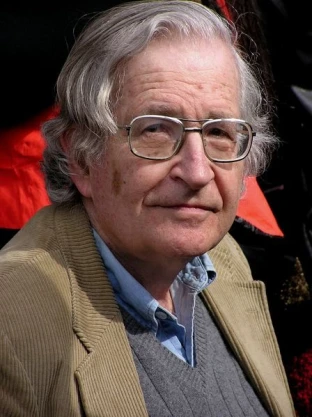
Noam Chomsky
Noam Chomsky is one of the most distinguished living scientists, with important contributions that have revolutionized linguistics, and with important work on analytical philosophy. He is professor emeritus of linguistics and philosophy at MIT, and is often referred to as “the father of modern linguistics”. Among the wider public, he is even better known for his many books and essays on political developments, putting them into the context of history and economics. His books “Hegemony or Survival”, “Failed States”, among others, sharply criticising American politics, are bestsellers. His most recent book is “Hopes and Prospects”, a collection of essays that include analyses of most recent political developments. The first chapter can be used to give an explanation for what might be called the American attitude: what are the principles underlying American politics? Are these attitudes unique?
Globalization for Whom?
The first chapter of Noam Chomsky’s book deals with the benefits and disadvantages of globalization and the ideology behind it. A brief outline with a few excerpts (in parentheses) follows.
1. Colonization
Pages 3-6: On the first pages of the book, Chomsky discusses the European colonization of the Americas, with “hideous consequences for the indigenous population”, and similar consequences for Africans imported by the slave trade in one of the “vilest episodes of history.” He mentions “Britain’s terrible crimes in India”, and 1492, when Christian invaders “extended their barbaric sway over the most advanced and tolerant civilization in Europe, Moorish Spain” which led to the destruction of much of the ancient records of learning, similar to the destruction resulting from the Mongol invasion of Iraq, and to “the even worse destruction of civilization in the course of the U.S.-British invasion of Iraq”.
Chomsky points out that the reasons for the European successes were the epidemics caused by the “European filth” that decimated the much healthier population of the Western hemisphere, and the military superiority (and not any “social, moral or natural advantage”). Natives in America and Southeast-Asia were appalled by the “all-destructive fury of European warfare”.
Chomsky points out that he Western hemisphere, at the time before European colonization, had some of the “most advanced civilizations” on Earth. In eastern Bolivia, now one of the poorest countries, a “wealthy, sophisticated, complex” society existed, “one of the largest, strangest, and ecologically richest artificial environments” on Earth, with perhaps one million people. In Peru, the Inka empire was the greatest on Earth. In the United States, perhaps seven million native people lived, reduced to a few hundred thousand by 1900.
Chomsky further refers to China and India, which – before colonization – were “the world’s major commercial and industrial centres”.
Pages 7ff: Chomsky has in earlier books discussed the fate of Haiti, with whose history he is well familiar. Here he states that Haiti “was probably the richest colony in the world” contributing much to the wealth of its colonial master, France. Chomsky describes in some detail how Haiti overthrew the French occupants which were supported by Britain and the U.S. in 1804, but had to pay a huge indemnity to this day from which Haiti never recovered. Very recently (in 2004), the democratically elected President of Haiti, who asked to have the indemnity terminated, was overthrown by the U.S. and France. The U.S. had earlier (in 1915) invaded Haiti, restoring “virtual slavery” and killing many thousands, opening the way for the takeover of the country by U.S. corporations (not in Chomsky: a prominent U.S. evangelical preacher announced that this year’s earthquake in Haiti was punishment for the pact Haitians had concluded with the devil when overthrowing the French in their revolution 200 years ago. – To a meeting of donor nations to Haiti after its devastating earthquake, Cuba and Venezuela, which had contributed more than many if not all others, were not invited. Venezuela had cancelled Haiti’s debt, the others have not). – Chomsky describes how terror in Haiti increased under the dictatorships of the National Guard and president Duvalier, supported by the U.S., and later (under Bush I and Clinton) under a military junta. ”Meanwhile neoliberal policies dismantled what was left of economic sovereignty….”.
Page 24: Chomsky points out that British colonizers “were astonished at the wealth, and sophisticated civilization of Bengal, which they regarded as one of the richest prizes in the world”. He mentions that Dacca was as great a city (in population, wealth etc.) as the city of London. However, 100 years later (under British colonial rule) the population of Dacca had fallen from 150,000 to 30,000 in a country “reverting to jungle and malaria”. The British forced farmers to grow poppies for opium export to China, whose ports were opened by force in the opium wars, leading to enormous sufferings of the Chinese people. (Not in Chomsky: According to the Indian author Madhusree Mukerjee: Churchill’s Secret War [2], more than a million people died 1943 in a famine in Bengal, according to Tom Keneally: Three Famines [3], about three million; Churchill refused to allow ships that were transporting cereals from Australia to the Mediterranean to be diverted to India, although the U.S. and Australia had offered help. Would he have reacted in the same way if not Indians but British people were starving? According to Richard Toye, Churchill’s Empire [4], this was the opinion of Churchill about Indians: “I hate Indians. They are beastly people with a beastly religion” who “breed like rabbits”).
2. Morality of colonization
Pages 16-17: About all this, three prominent U.S. historians wrote in a standard high school textbook not long ago: “ Accordingly, the story of Europeans in the empty New World’ is the story of the creation of civilization were none existed”. Importantly, this view is shared by the cultural and political heroes of early U.S. history. Walt Whitman: “What has miserable, inefficient Mexico…to do with the great mission of peopling the New World with a noble race?” Ralph Waldo Emerson: “It is very certain that the strong British race which has now overrun much of the continent, must also overturn that trace, and Mexico and Oregon also, and it will in the course of ages be of small import by what particular occasions and methods it was done”. The leading scholar of U.S. diplomatic historian Thomas Bailey in 1969: “….the united thirteen colonies could “concentrate on the task of felling trees and Indians ….” George Washington: “We must induce [the Aborigines] to relinquish our Territories and to remove into the illimitable regions of the West” – which we were to “induce” them to leave later on, for heaven. The Territories became “ours” by right of conquest as the “Aborigines” were regularly instructed.”
Thomas Jefferson: ,,,the country will ultimately be “free of blot or mixture”, and “it will be the nest, from which all America, North and South, is to be peopled” ……with people speaking the same language”.
Pages 19-22: “Henry Knox (first secretary of war in the united colonies) in a similar vein anounced…..the utter extirpation of all the Indians in most populous parts… more destructive to the Indian natives than the conducts of the conquerors of Mexico and Peru”.
…However, others have expressed misgivings, so President John Quincy Adams: “….that hapless race of native Americans, which we are exterminating with such merciless and perfidious cruelty, among the heinous sins of this nation, for which I believe God will one day bring [it] to judgment”.
But, of course, conveniently there is another version of history, as expressed by Supreme Court Justice Joseph Story: “the wisdom of Providence, “inscrutable to mere mortals, caused the natives to disappear like “wittered leaves of autumn” even though the colonists had “constantly respected” them””, or President Monroe: “We become in reality their benefactors by expelling natives from their homes”. Or President Theodore Roosevelt, who said that the European expansion over the last four centuries was of lasting benefit to the natives (not in Chomsky: Pope Benedict, on his recent visit to South America, proclaimed that the natives really wanted conversion to Christianity, for which he was sharply rebuked by president Hugo Chavez of Venezuela).
3. Economic aggression
Pages 80 etc.: Apart from direct military aggression that is undertaken to promote economic interests of the aggressor, history shows that powerful countries like Britain and the USA have refused economic liberalism, in other words, protected their economies from undesirable imports (protectionism), as long as it was in their own interest. Weaker countries, however, were induced by various means including military ones to open their markets to imports. This, according to Noam Chomsky, created the Third World. One of the many examples is Haiti. Only once powerful countries had reached a certain level of economic strength, did they open their markets as well, now following Riccardo’s principle of comparative advantage.
4. The City on the Hill
Contradicting people who see the bad in colonization, New York Times columnist Roger Cohn stated that- unlike other states – “America was born as an idea”, a city on a hill ( the term was coined in 1630 outlining the “glorious future of a new nation ordained by God”), “an inspirational notion” that resides “deep in the American psyche”.
Pages 22 etc.: and this notion has governed Amercian policy to this day, used as an excuse to colonize Cuba, attack the Phillippines in a murderous war, and for the invasion of Iraq. This notion can be differently formulated, as in the Clinton doctrine, according to which the U.S. is “entitled to resort to “unilateral use of military power “ to ensure “uninhibited access to key markets, energy supplies and strategic resources”.
5. And this continued through history to this day and is continuing
Chomsky gives numerous examples of American military and economic aggression, some of its tools including the World Bank, International Monetary Fund, among others. (See also http://blog.une.edu.au/klausrohde/2008/02/09/the-worlds-future-at-stake-the-us-elections)
Extracts: “America is a country that is comfortable with war. In the 230 years since the Declaration of Independence, the US has invaded other countries on more than 200 occasions, according to the Congressional Research Service. That is an average of one foreign incursion every 14 months in the nation’s history. —– The Pentagon’s budget today, after adjusting for inflation, exceeds its Cold War average by one-eighth, though there is no longer any nation that could be called a peer competitor. — The total defence budget is bigger than that of all other nations combined.”)
6. But America is not unique
And importantly, as pointed put by Chomsky repeatedly, America is just one case of imperial powers in history that have used similar justifications, although details of methods used differ of course. (The Soviet Union promised a workers’ paradise on Earth, the Nazis wanted to exterminate the jews, the source of all evil, etc.).
1. Noam Chomsky: Hopes and Prospects. Hamish Hamilton, 2010.
2. Madhusree Mukerjee: Secret War, The British Empire and the Ravaging of India During World War II, 2010.
3. Tom Keneally: Three Famines. Knopf, 2010.
4. Richard Toye: Churchills’ Empire, 2010.
 Klaus Rohde